
7-month-old sleep schedule: naps, nights and a sample day

A 7-month-old needs 12 to 16 hours of sleep in 24, naps included: a longer stretch at night and at least two naps by day. Some babies still take three. No health body publishes wake windows for this age or set nap times, so the sample day below is one example built from those totals, not a target.
7-month-old sleep at a glance
| At 7 months | Who says so (age band) | |
|---|---|---|
| Total sleep in 24 hours | 12 to 16 hours, naps included | CDC and AAP (4 to 12 months) |
| Night | A longer stretch, often 9 hours or more with brief wakings. Up to 12 hours for some babies | KidsHealth (by 6 months), Lullaby Trust (6 to 12 months) |
| Naps | At least two. Some babies still take three | KidsHealth (4 to 7 months) |
| Daytime sleep in total | About 3 to 4 hours | KidsHealth (4 to 7 months) |
| Awake time between sleeps | Not published by any health body. Our worked example below comes to about 3 to 3½ hours on a two-nap day | Arithmetic, not guidance |
| Night feeds | Some babies no longer need one. Others still wake for it | NHS (6 months to a year), KidsHealth (4 to 7 months) |
| Sleep position | On their back for every sleep until age 1 | AAP, NICHD |
How much sleep does a 7-month-old need?
The 12 to 16 hours for babies between 4 and 12 months comes from the American Academy of Sleep Medicine, as quoted by the CDC, and the American Academy of Pediatrics supports it. An NHS trust puts the real test simply: if your baby is growing, alert and happy when awake, they are getting enough sleep.
How long should a 7-month-old be awake between naps?
No health body publishes wake windows for this age. The ranges on other sites are rules of thumb from sleep coaches and baby apps. They aren't health guidance.
Here is one example worked out from the published totals:
- A night of about 11½ hours plus two naps of about 1½ hours each is 14½ hours of sleep, inside the 12 to 16 hours.
- That leaves about 9½ hours awake.
- A two-nap day has three awake stretches, so each comes to roughly 3 to 3½ hours.
- A three-nap day splits the same time four ways, so each stretch is nearer 2¼ to 2½ hours.
Your baby's cues matter more than any number. The AAP's advice is not to wait for eye rubbing or yawning before bed, because that's probably too late. An NHS trust's leaflet lists quieter cues: going quiet, being less engaged, a glazed look, frowning or pulling at their ears. It calls crying and irritability late signs.
A sample 7-month-old day
Here is one example built from those totals, not a target. Times are rounded to the quarter hour.
| Two-nap day | Three-nap day | |
|---|---|---|
| Wake up | 7:00 a.m. | 7:00 a.m. |
| First nap | 10:00 to 11:30 a.m. | 9:30 to 10:45 a.m. |
| Second nap | 2:30 to 4:00 p.m. | 1:15 to 2:30 p.m. |
| Third nap | None | 5:00 to 5:45 p.m. |
| Bedtime routine | 7:00 p.m. | 7:30 p.m. |
| Asleep | 7:30 p.m. | 8:00 p.m. |
| Daytime sleep | 3 hours | 3¼ hours |
| Night | About 11½ hours | About 11 hours |
In this example the late catnap pushes bedtime back by half an hour and shortens the night.
The 7-month-old nap schedule: two naps or three?
No health body gives an age for dropping from three naps to two. KidsHealth says babies of 4 to 7 months take at least two naps, and its guidance on naps gives two to three for anywhere from 4 to 12 months. For 8 to 12 months it says your baby will likely still take two. So at seven months, two and three both fit. Our 8-month-old sleep schedule shows the two-nap day once it has settled.
Your own days are the best evidence. For a few days, note whether the third nap happens at all and what time bedtime ends up. When you do move to two naps, bring bedtime forward while your baby adjusts. The AAP says putting a child to bed even 15 to 20 minutes earlier can make a big difference.
Night sleep at 7 months
KidsHealth says most babies are sleeping 9 hours or longer at night by 6 months, with brief awakenings. The Lullaby Trust says babies of 6 to 12 months may sleep up to 12 hours at night, though teething, illness or hunger can mean they wake more often again.
The American Academy of Pediatrics says it is normal for a 6-month-old to wake during the night and go back to sleep after a few minutes. So it's worth waiting a few minutes before you go in. You still go in for a feed, a dirty diaper or a baby who seems unwell. If you feed or change your baby, try not to wake them fully, and speak softly.
What else can change sleep at 7 months?
First teeth
The AAP says first teeth typically appear between 6 and 10 months. Gentle pressure on the gums or a cold teething cloth can help a baby who wakes. Teething does not cause fever, diarrhea or excess crying, the AAP says. A fever of 100.4°F (38°C) or higher points to an illness or infection, so call your doctor rather than putting it down to teeth.
Early clinginess
Separation anxiety usually comes a little later, but not always. The AAP says some babies show it as early as 4 to 5 months, while most develop it more strongly at around 9 months. Our 10-month-old sleep schedule covers what helps.
Is this a sleep regression?
"Sleep regression" isn't a medical term, and no health body describes one at seven months. Our guide to sleep regressions by age covers each age, and the four-month sleep regression guide explains what changed at four months.
How do I help my 7-month-old settle at bedtime?
- A short, soothing routine. The NHS says a simple, soothing bedtime routine may help your baby settle. Its examples include a bath, a story, dimmed lights and a cuddle.
- Drowsy, not asleep. For babies 4 months and older, the AAP's advice is to put them to bed drowsy rather than waiting until they are asleep. A baby who is rocked to sleep may struggle to go back to sleep when they wake in the night.
- Calm before bed. The AAP recommends dim lights before bed and screens off at least an hour before.
The guidance we cite doesn't recommend or name a sleep-training method. It's a choice to talk through with your pediatrician.
How do I keep my 7-month-old's sleep safe?
Most SIDS deaths happen before 6 months, but SIDS can happen at any time in the first year, NICHD's Safe to Sleep campaign says, so these rules hold until the first birthday:
- On their back for every sleep, naps included, until their first birthday. If your baby rolls both ways by themselves, NICHD says you can leave them in whatever position they roll into. If they can only roll one way, turn them onto their back again.
- Nothing in the crib but a fitted sheet. No pillows, blankets, bumpers, soft toys or loveys.
- Not too warm. The AAP suggests a room temperature of 68°F to 72°F.
- A room, not a bed. The AAP, NICHD, KidsHealth and the NHS all advise sharing a room, not a bed, for at least the first 6 months. Some AAP guidance prefers up to a year.
- Stop swaddling if you haven't yet. The AAP says to stop as soon as your baby looks like they are trying to roll over, which usually happens around 3 to 4 months.
- Lower the crib mattress before your baby can sit. The AAP says to set it at its lowest position before they learn to stand.
When to check with your doctor
KidsHealth says to talk with your doctor if you have questions about your baby's sleep. The AAP lists frequent snoring, problems breathing during the night and daytime sleepiness as possible signs of sleep apnea: tell your pediatrician right away. And if broken nights leave you struggling to cope, tell your doctor that too.
Call your pediatrician today about a fever. A temperature of 100.4°F (38°C) or higher is a fever. For babies older than 6 months, the American Academy of Pediatrics advises calling your doctor about a temperature of 103°F (39.4°C) or higher, or a fever that lasts more than 24 hours. Call straight away if your baby has a fever and:
- looks very ill, is unusually drowsy or is very fussy
- has had a seizure
Emergency. The NHS says to call your emergency number (911 in the US, 999 in the UK) or go to the emergency department if a baby:
- is breathing very fast or has difficulty breathing
- has blue, gray, pale or blotchy skin, lips or tongue
- has a rash that does not fade when you press it
- has fainted, is difficult to wake or cannot be woken
- has a weak, high-pitched or continuous cry
- is having a seizure (fit)
The AAP also says to call your emergency number if your baby's breathing stops for more than 20 seconds or their skin turns pale, bluish or grayish.
Urgent medical help. The NHS lists more signs of serious illness, such as being floppy, pausing when breathing or breathing irregularly. If your baby is unwell and you think something is seriously wrong, trust your instincts and get immediate medical help.
Frequently asked questions
How many naps should a 7-month-old take?
Two or three. KidsHealth says babies of 4 to 7 months take at least two naps, with about 3 to 4 hours of daytime sleep in total. If it keeps pushing bedtime late, two may suit your baby better.
Does a 7-month-old still need to eat at night?
Some do. The NHS says that for some babies between 6 months and a year, night feeds may no longer be necessary, while KidsHealth notes that breastfed babies in particular may still wake at night. There is no set age to stop, so ask your pediatrician before you drop a night feed.
Should my 7-month-old be sleeping through by now?
Some babies are. Many aren't, and both are normal. The Lullaby Trust says around a third of babies have never slept all night by 12 months.
What time should a 7-month-old go to bed?
No health body sets a clock time. The AAP's advice is to choose a regular bedtime and stick to it. Count back from your usual morning by the length of night your baby sleeps: a baby who sleeps about 11 hours and wakes at 7 a.m. would go down around 8 p.m.
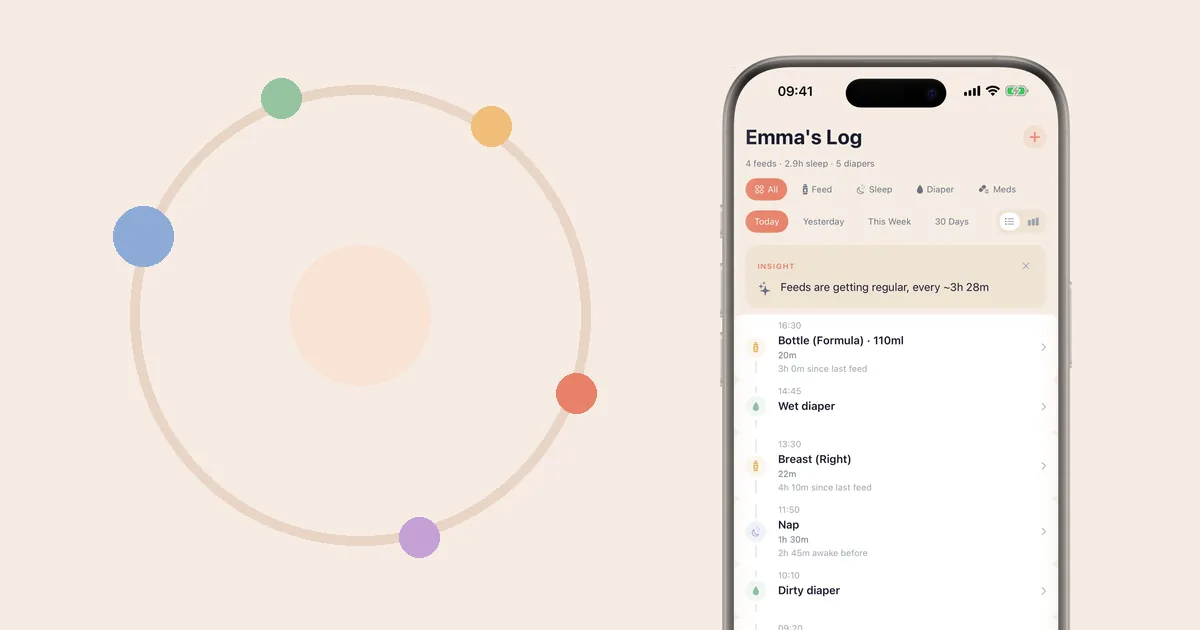
Log a few days of naps in TandemBaby and the Orbit lays them out on one 24-hour circle, so both of you can see whether the third nap still fits. For the next stage, see the 8-month-old sleep schedule, or every age in our baby sleep schedules by age.
Sources
- About Sleep, Centers for Disease Control and Prevention
- Healthy Sleep Habits: How Many Hours Does Your Child Need?, American Academy of Pediatrics, HealthyChildren.org
- Baby Sleep: 4- to 7-Month-Olds, KidsHealth (Nemours)
- Naps, KidsHealth (Nemours)
- Baby Sleep: 8- to 12-Month-Olds, KidsHealth (Nemours)
- Baby sleep patterns: how long should my baby sleep?, The Lullaby Trust
- Helping your baby to sleep, NHS
- Getting Your Baby to Sleep, American Academy of Pediatrics, HealthyChildren.org
- Brush, Book, Bed: How to Structure Your Child's Nighttime Routine, American Academy of Pediatrics, HealthyChildren.org
- Make Baby's Room Safe: Parent Checklist, American Academy of Pediatrics, HealthyChildren.org
- How to Keep Your Sleeping Baby Safe: AAP Policy Explained, American Academy of Pediatrics, HealthyChildren.org
- Safe Sleep: 9 Ways to Reduce a Baby's Risk of SIDS & Suffocation, American Academy of Pediatrics, HealthyChildren.org
- Ways to Reduce Baby's Risk, NICHD Safe to Sleep
- FAQs, NICHD Safe to Sleep
- How to Ease Your Child's Separation Anxiety, American Academy of Pediatrics, HealthyChildren.org
- Teething Pain Relief: How to Soothe Your Baby's Discomfort, American Academy of Pediatrics, HealthyChildren.org
- Baby's First Tooth: 7 Facts Parents Should Know, American Academy of Pediatrics, HealthyChildren.org
- Fever and Your Baby, American Academy of Pediatrics, HealthyChildren.org
- Fever: When to Call the Pediatrician, American Academy of Pediatrics, HealthyChildren.org
- Sleep Apnea in Children: Detection & Treatment, American Academy of Pediatrics, HealthyChildren.org
- When to get urgent medical help for babies and children under 5, NHS
- Your baby's sleep at... 6 - 12 months, Wirral Community Health and Care NHS Foundation Trust
- How much will my baby sleep in their first year?, Derbyshire Community Health Services NHS Foundation Trust
This is educational content, not medical advice. It is not a substitute for personal advice from your pediatrician, midwife or health visitor, who know your baby.