
8-month-old sleep schedule: naps, nights and why waking comes back

An 8-month-old needs 12 to 16 hours of sleep in 24, naps included, usually as two naps and a night of 9 to 12 hours. Waking more at night again is common at this age, and normal. No health body publishes wake windows for this age, so the sample day below is one example, not a target.
8-month-old sleep at a glance
| At 8 months | Who says so (age band) | |
|---|---|---|
| Total sleep in 24 hours | 12 to 16 hours, naps included | KidsHealth (8 to 12 months), CDC and AAP (4 to 12 months) |
| Night | 9 to 12 hours. Wakings are common | KidsHealth (8 to 12 months) |
| Naps | Likely two | KidsHealth (8 to 12 months) |
| Length of each nap | 30 minutes to 2 hours | KidsHealth (8 to 12 months) |
| Daytime sleep in total | No health body gives a figure for this age | None |
| Awake time between sleeps | Not published by any health body. Our worked example comes to about 3¼ to 3½ hours | Arithmetic, not guidance |
| Waking more again | Normal for some babies at 8 to 9 months | Two NHS trusts |
| Sleep position | On their back for every sleep until age 1 | AAP, NICHD |
How much sleep does an 8-month-old need?
KidsHealth says most babies 8 to 12 months old should sleep 12 to 16 hours a day, including a stretch of 9 to 12 hours at night.
How long should an 8-month-old be awake between naps?
No health body publishes wake windows for this age. The awake-time ranges you'll see elsewhere come from sleep coaching and baby apps, and are best used as a loose starting point.
One example, worked out from the published totals:
- A night of 11 hours, inside KidsHealth's 9 to 12.
- Two naps of about 1½ hours and 1¼ hours, inside its 30 minutes to 2 hours each.
- That's about 13¾ hours of sleep in all, inside the 12 to 16 hours, which leaves about 10¼ hours awake.
- A two-nap day has three awake stretches, so each comes to roughly 3¼ to 3½ hours.
A sample 8-month-old day
This is one example built from the totals above, not a target. Times are rounded to the quarter hour.
| Time | What happens |
|---|---|
| 6:30 a.m. | Wake up |
| 9:45 to 11:15 a.m. | First nap, about 1½ hours |
| 2:45 to 4:00 p.m. | Second nap, about 1¼ hours |
| 7:00 p.m. | Bedtime routine |
| 7:30 p.m. | Asleep |
| 7:30 p.m. to 6:30 a.m. | Night, about 11 hours, often with some waking |
The 8-month-old nap schedule
Two naps is the usual pattern now. No health body gives an age for dropping a third nap. KidsHealth's guidance on naps gives two to three a day for anywhere from 4 to 12 months, so a baby who still needs a short third nap on some days isn't behind. If your baby has only just moved to two naps, our 7-month-old sleep schedule covers the switch.
What helps naps go well:
- The same short routine every time. KidsHealth suggests soft music, dim lights and a quiet story, then putting your baby down sleepy but not yet asleep.
- Naps on the move. If your baby falls asleep in a car seat, stroller, swing or carrier, the AAP says to move them to a firm, flat sleep surface as soon as you can.
Night sleep at 8 months: why is my baby waking again?
If your baby has started waking again, it's common and it isn't your doing. Two NHS trusts say it is normal for some babies to start waking more at night again at 8 to 9 months. An article on the AAP's HealthyChildren.org puts it more broadly: night waking phases come and go in the first few years of life, often without any explanation.
Things that can play a part at this age:
- Separation anxiety. KidsHealth says it develops between 8 months and 1 year. It usually peaks a little later, so our 10-month-old sleep schedule covers it in depth.
- Crawling and pulling up. The AAP says crawling is usually mastered between seven and ten months, and babies then pull themselves up to stand every chance they get. An NHS trust notes that a burst of new movement skills may disrupt sleep.
- Teeth. The NHS says the teeth either side of the front teeth usually come through at around 8 months.
How many night wakings are normal?
No national health body gives a number. One NHS trust's guidance says all babies over 5 months wake 4 to 6 times a night as they come to the end of each sleep cycle, and that it's the falling back to sleep that can be difficult.
What helps at night
- Give it a few minutes. The AAP article suggests waiting to see if your baby drifts back off, which often happens if you don't step in right away. If the crying goes on, keep the lights dim, check that everything is all right, then pat and reassure your baby without picking them up. Leave once they're calm but still awake.
- Keep it quiet and dull. If you feed or change your baby, try not to wake them fully, and speak softly if you speak at all.
- Take turns. If there are two of you, one of you covers the first part of the night and the other the second, so each of you gets one longer stretch of sleep.
Is there an 8-month sleep regression?
"Sleep regression" is a parents' term, not a medical one, and no health body describes an 8-month regression as such. Our guide to sleep regressions by age puts each age side by side, and the four-month sleep regression guide explains the first big change in how babies sleep.
Does teething wake an 8-month-old?
It can. KidsHealth says teething is painless for some babies, while others seem cranky for weeks, with crying spells and disrupted sleeping and eating. For a baby who wakes, the AAP suggests a gentle gum massage or a cold teething cloth. The AAP says not to use teething tablets, homeopathic teething gels, gels with benzocaine or amber teething necklaces.
Teething does not cause fever, diarrhea or excess crying, the AAP says. A fever of 100.4°F (38°C) or higher points to an illness or infection, so call your doctor rather than putting it down to teeth.
How do I keep my 8-month-old's sleep safe?
Most SIDS deaths happen before 6 months, but SIDS can happen at any time in the first year, NICHD's Safe to Sleep campaign says, so these rules hold until the first birthday:
- On their back for every sleep, naps included, until their first birthday. If your baby rolls both ways by themselves, NICHD says you can leave them in whatever position they roll into. If they can only roll one way, turn them onto their back again.
- Nothing in the crib but a fitted sheet. No pillows, blankets, bumpers, soft toys or loveys.
- Not too warm. The AAP suggests a room temperature of 68°F to 72°F.
- A room, not a bed. The AAP, NICHD, KidsHealth and the NHS all advise sharing a room, not a bed, for at least the first 6 months. Some AAP guidance prefers up to a year.
- Lower the mattress now. The AAP says to set the crib mattress at its lowest position before your baby learns to stand.
- Check what they can reach. KidsHealth suggests looking for anything your baby could touch from a sitting or standing position in the crib: hanging mobiles, wall hangings, pictures, curtains and window blind cords.
When to check with your doctor
KidsHealth says to talk with your doctor if you have questions about your baby's sleep. The AAP lists frequent snoring, problems breathing during the night and daytime sleepiness as possible signs of sleep apnea: tell your pediatrician right away. And if broken nights leave you struggling to cope, tell your doctor that too.
Call your pediatrician today about a fever. A temperature of 100.4°F (38°C) or higher is a fever. For babies older than 6 months, the American Academy of Pediatrics advises calling your doctor about a temperature of 103°F (39.4°C) or higher, or a fever that lasts more than 24 hours. Call straight away if your baby has a fever and:
- looks very ill, is unusually drowsy or is very fussy
- has had a seizure
Emergency. The NHS says to call your emergency number (911 in the US, 999 in the UK) or go to the emergency department if a baby:
- is breathing very fast or has difficulty breathing
- has blue, gray, pale or blotchy skin, lips or tongue
- has a rash that does not fade when you press it
- has fainted, is difficult to wake or cannot be woken
- has a weak, high-pitched or continuous cry
- is having a seizure (fit)
The AAP also says to call your emergency number if your baby's breathing stops for more than 20 seconds or their skin turns pale, bluish or grayish.
Urgent medical help. The NHS lists more signs of serious illness, such as being floppy, pausing when breathing or breathing irregularly. If your baby is unwell and you think something is seriously wrong, trust your instincts and get immediate medical help.
Frequently asked questions
Why is my 8-month-old waking up at night again?
Two NHS trusts say it is normal for some babies to start waking more at 8 to 9 months, and separation anxiety, crawling, new teeth, hunger and illness can all play a part. If the waking comes with a fever or your baby seems unwell, call your doctor.
How many naps should an 8-month-old take?
Usually two. KidsHealth says babies of 8 to 12 months will likely still take two naps a day, lasting anything from 30 minutes to 2 hours each.
Should I let my 8-month-old cry it out?
The guidance we cite doesn't recommend or name a sleep-training method, so it's a choice to talk through with your pediatrician. The AAP suggests giving a waking baby a few minutes to settle, then reassuring them without picking them up. Some NHS services prefer responding quickly and don't recommend leaving a baby to cry.
Does an 8-month-old still need a night feed?
Many still wake for one. The NHS says that for some babies between 6 months and a year, night feeds may no longer be necessary, and an NHS trust says it is usual for babies of this age to still wake for feeds. Ask your pediatrician before you drop one.
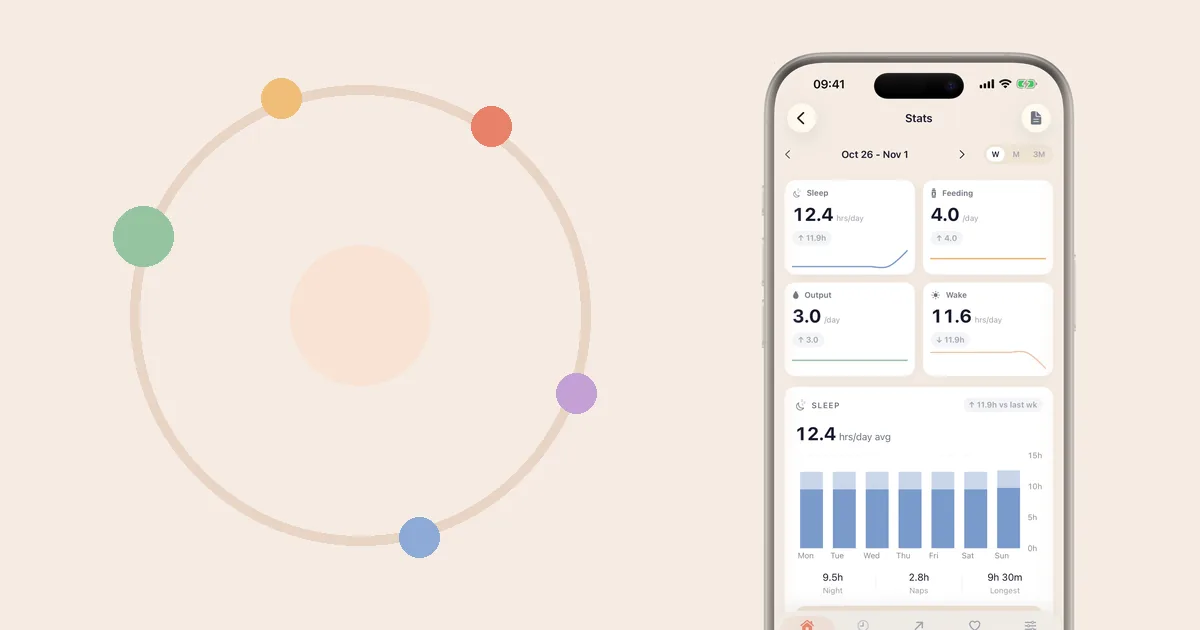
When nights get broken again, whoever is on next can open TandemBaby and see how the night has gone so far, and over a week or two the Orbit shows whether the wakings are thinning out. For the ages either side, see the 7-month-old sleep schedule and the 10-month-old sleep schedule, or every age in our baby sleep schedules by age.
Sources
- Baby Sleep: 8- to 12-Month-Olds, KidsHealth (Nemours)
- About Sleep, Centers for Disease Control and Prevention
- Healthy Sleep Habits: How Many Hours Does Your Child Need?, American Academy of Pediatrics, HealthyChildren.org
- Naps, KidsHealth (Nemours)
- Getting Your Baby to Sleep, American Academy of Pediatrics, HealthyChildren.org
- Sleeping Like a Baby: Stories & Tips From the Front Lines, American Academy of Pediatrics, HealthyChildren.org
- Sleep (infants 0 to 12 months), Children's Sleep Service, Newcastle upon Tyne Hospitals NHS Foundation Trust
- How much will my baby sleep in their first year?, Derbyshire Community Health Services NHS Foundation Trust
- Sleep, Healthier Together, Shropshire, Telford and Wrekin (NHS)
- Separation Anxiety, KidsHealth (Nemours)
- Movement Milestones in Babies 8 to 12 Months Old, American Academy of Pediatrics, HealthyChildren.org
- Baby teething symptoms, NHS
- Teething Tots, KidsHealth (Nemours)
- Teething Pain Relief: How to Soothe Your Baby's Discomfort, American Academy of Pediatrics, HealthyChildren.org
- Baby's First Tooth: 7 Facts Parents Should Know, American Academy of Pediatrics, HealthyChildren.org
- Helping your baby to sleep, NHS
- Your baby's sleep at... 6 - 12 months, Wirral Community Health and Care NHS Foundation Trust
- Social and Emotional Development: 9 Months Old, American Academy of Pediatrics, HealthyChildren.org
- Safe Sleep: 9 Ways to Reduce a Baby's Risk of SIDS & Suffocation, American Academy of Pediatrics, HealthyChildren.org
- How to Keep Your Sleeping Baby Safe: AAP Policy Explained, American Academy of Pediatrics, HealthyChildren.org
- Make Baby's Room Safe: Parent Checklist, American Academy of Pediatrics, HealthyChildren.org
- Ways to Reduce Baby's Risk, NICHD Safe to Sleep
- FAQs, NICHD Safe to Sleep
- Fever and Your Baby, American Academy of Pediatrics, HealthyChildren.org
- Fever: When to Call the Pediatrician, American Academy of Pediatrics, HealthyChildren.org
- Sleep Apnea in Children: Detection & Treatment, American Academy of Pediatrics, HealthyChildren.org
- When to get urgent medical help for babies and children under 5, NHS
This is educational content, not medical advice. It is not a substitute for personal advice from your pediatrician, midwife or health visitor, who know your baby.