
Baby sleep schedules by age

Babies need about 14 to 17 hours of sleep a day as newborns, 12 to 16 hours from 4 to 12 months and 11 to 14 hours from 1 to 2 years, naps included. A predictable schedule only takes shape after the newborn weeks: most babies have a regular pattern by three to six months.
A baby sleep schedule is less a timetable you set than a pattern your baby grows into. The numbers below show how much sleep babies need at each age. The guides further down go into each stage.
How much sleep do babies need?
| Age | Sleep in 24 hours, naps included | Naps |
|---|---|---|
| 0 to 3 months | About 14 to 17 hours | Sleep is spread over day and night |
| 4 to 12 months | 12 to 16 hours | Usually two to three a day |
| 1 to 2 years | 11 to 14 hours | Most drop to one nap by 18 months |
The newborn range comes from the US National Sleep Foundation and the others from the American Academy of Sleep Medicine, both as quoted by the CDC. The World Health Organization uses very similar ranges. Other health bodies give slightly different figures: the American Academy of Pediatrics says newborns sleep about 16 to 17 hours, and the NHS says around 18. Naps are from KidsHealth.
Why are the numbers ranges?
Because healthy babies differ. Each range is three to four hours wide for that reason. Use the table to see whether your baby is roughly in the expected zone, not to hit an exact number.
When does a sleep schedule start to work?
Not straight away. Newborns have no sense of day and night, and sleep follows feeds. The American Academy of Pediatrics says a day and night rhythm starts to show around six weeks and most babies have a regular pattern by three to six months. Our guide to newborn sleep, week by week walks through the first twelve weeks.
Around four months sleep changes again, as cycles become more regular. That is the stage many parents know as the four-month sleep regression.
From then on, a predictable routine has something to work with. The NHS recommends a calming, predictable bedtime routine at the same time each night for young children. For what a day can look like later in the first year, see the 7-month-old sleep schedule, the 8-month-old sleep schedule and the 10-month-old sleep schedule.
When to check with your doctor
Talk to your doctor or health visitor if your baby's sleep changes suddenly along with poor feeding, fewer wet diapers, a fever or a baby who doesn't seem their usual self. If you are so short of sleep that you are struggling to cope, say so too.
0 to 3 months
- Newborn sleep schedule, week by week
About 14 to 17 hours a day, an hour or two at a time. What changes between week 1 and week 12, and when nights start to get longer.
4 to 12 months
- 7-month-old sleep schedule: naps, nights and a sample day
12 to 16 hours a day, a longer night and two or three naps. When the third nap stops fitting, and a sample two-nap day. - 8-month-old sleep schedule: naps, nights and why waking comes back
12 to 16 hours a day, usually two naps and a night of 9 to 12 hours. Why night waking is common again around now, and what helps. - 10-month-old sleep schedule: naps, bedtime and separation anxiety
12 to 16 hours a day and usually still two naps. What helps when separation anxiety peaks and your baby stands up in the crib at bedtime.
1 to 2 years
- 17-month-old sleep schedule: one nap, bedtime and a sample day
11 to 14 hours a day, and many toddlers are moving to one afternoon nap. What helps when your toddler fights the nap, resists bedtime or wakes looking for you.
Frequently asked questions
How many hours should a baby sleep?
About 14 to 17 hours a day in the first three months, 12 to 16 hours from 4 to 12 months and 11 to 14 hours from 1 to 2 years, naps included. These are ranges, because healthy babies vary.
How many naps does a baby need?
Between 4 and 12 months most babies take two to three naps a day. Most toddlers drop down to one nap a day by 18 months, KidsHealth says.
When can I put my baby on a sleep schedule?
Not in the newborn weeks, when sleep follows feeds. A day and night rhythm starts to show around six weeks and most babies have a regular pattern by three to six months, so that is when a routine has something to work with.
When do babies sleep through the night?
Early on, "through the night" means a stretch of 5 to 6 hours, which some babies manage by 2 to 3 months. The NHS says some babies sleep 5 to 8 hours or longer at night by three to six months, but not all.
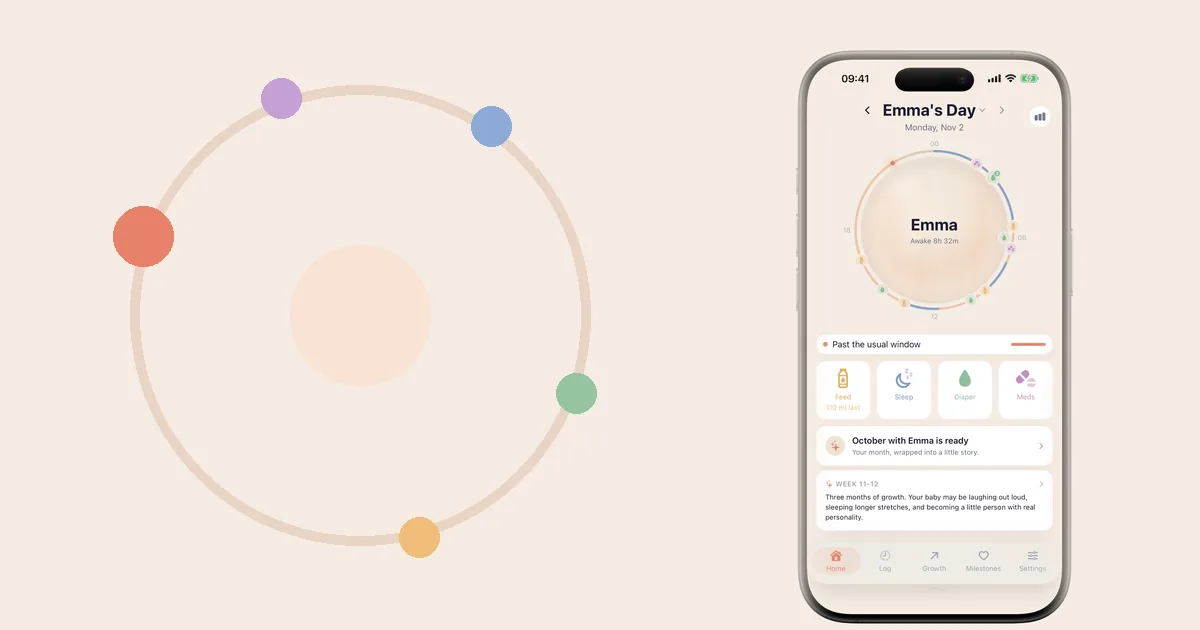
Every baby's schedule is their own. Log sleep for a few days in TandemBaby and the Orbit shows your baby's actual pattern on one 24-hour circle, the same picture on both parents' phones.
Sources
- About Sleep, Centers for Disease Control and Prevention
- Sleep, American Academy of Pediatrics, HealthyChildren.org
- A Lullaby for Good Health, American Academy of Pediatrics, HealthyChildren.org
- Naps, KidsHealth (Nemours)
- Sleep and Your Newborn, KidsHealth (Nemours)
- Helping your baby to sleep, NHS
- Sleep and young children, NHS
- To grow up healthy, children need to sit less and play more, World Health Organization
This is educational content, not medical advice. It is not a substitute for personal advice from your pediatrician, midwife or health visitor, who know your baby.